Updated October 2026 · By Daniel Tom, owner, Bay Area Sanitation
Short answer: During wildfire season, evacuation centers, cleanup crews and rebuild sites need restrooms fast, and demand spikes at the same time. Line up a provider before fire season, know how many units and hand wash stations each site needs, and pick placements a service truck can reach. Construction-style rentals bill every 28 days with weekly service.
Wildfire season in California doesn’t wait for anyone to be ready for it. Evacuation centers open with almost no notice, cleanup crews get mobilized within days of a fire being contained, and property managers suddenly need sanitation solutions for sites that had none the week before. If you’re responsible for coordinating any part of that response in the Bay Area, portable restrooms are one of the fastest and most overlooked pieces of the puzzle.
Here’s what to know about renting portable restrooms during wildfire season, and why planning ahead matters more than it seems.
Why Wildfire Season Creates a Sanitation Gap
When a wildfire forces evacuations, the facilities people normally rely on (homes, offices, public buildings) can become inaccessible almost overnight. Evacuation centers set up in fairgrounds, community centers, and parking lots often don’t have enough permanent restroom capacity to handle a sudden influx of displaced residents. The same is true for the cleanup and rebuilding phase that follows: crews working on debris removal, utility restoration, or property assessment in a burn area typically have no water or sewer access at all.
This is exactly the kind of temporary, high-need, no-infrastructure situation portable restrooms are built for. The challenge is timing. Units that are ordered after the need becomes urgent take longer to arrive than units that were already part of a response plan.
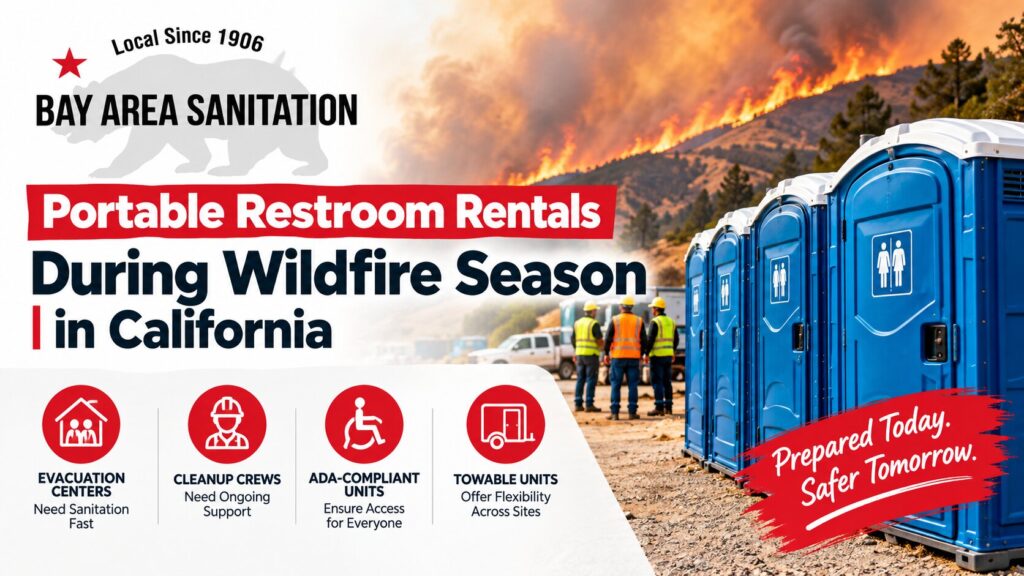
Evacuation Centers Need Sanitation Fast
Local governments, Red Cross chapters and community groups that run evacuation shelters often have to scale up within hours. A shelter can fill far beyond its planned headcount in a single day if a fire spreads, and restroom capacity that seemed adequate in the morning can be overwhelmed by evening.
Having a provider lined up before fire season starts, instead of searching for one mid-crisis, makes a real difference in how quickly units arrive. We deliver Monday through Friday, 7 AM to 4 PM.
Cleanup and Rebuild Crews Need Ongoing Support
Once a fire is contained, the work is far from over. Debris removal crews, insurance adjusters, contractors, and utility workers move into burn areas long before permanent facilities are restored. These crews often work in areas similar to job sites: no running water, no sewer connection, and a schedule that can run for weeks or months depending on the scope of the damage.
Standard portable restrooms are typically sufficient for these crews, though sites with larger teams may need multiple units serviced on the same schedule used for construction projects. For crews that need to move locations as work progresses across a burn area, a towable porta potty is often the more practical option since it can be relocated without a separate delivery truck each time.
Hillside and Wildland-Urban Interface Communities Face Higher Risk
Communities in the wildland-urban interface, where development meets dense vegetation, face some of the highest wildfire risk in the Bay Area. The Oakland Hills fire of 1991 remains one of the starkest reminders of how quickly fire can move through hillside neighborhoods, and it’s part of why cities like Oakland continue to prioritize fire preparedness in hillside districts. Property managers and HOAs in similarly situated communities across the East Bay hills, the Oakland-Berkeley hills corridor, and parts of the North Bay should factor sanitation into their broader emergency preparedness planning, not just water and evacuation routes.
What This Means If You Manage Property or Coordinate Response Efforts
If you’re responsible for a property, a community organization, or a response team that could be activated during wildfire season, a few things are worth doing before the season peaks:
- Identify a sanitation provider ahead of time rather than during an active emergency
- Understand roughly how many units your site or shelter would need based on expected occupancy
- Confirm servicing availability, since a shelter operating for days or weeks needs the same reliable servicing schedule as a construction site
- Factor in accessibility needs, since evacuation centers serving the general public should include ADA-compliant units alongside standard ones
Planning Ahead Reduces Response Time When It Matters Most
Wildfire response moves fast, and sanitation shouldn’t be the thing that slows it down. Whether you’re supporting an emergency situation in San Francisco or coordinating cleanup across a burn area elsewhere in the Bay Area, having a plan in place before fire season escalates means one less thing to figure out during an actual emergency.
Frequently asked questions
How quickly can portable restrooms be delivered during a wildfire emergency?
Delivery timelines depend on current demand and location, but organizations with an existing relationship with a provider generally see faster turnaround than those reaching out for the first time mid-emergency. Establishing that relationship before fire season is the best way to reduce wait times.
How many portable restrooms does an evacuation center need?
It depends on expected occupancy and how long people stay. Plan for capacity that can scale quickly, since evacuee numbers can climb faster than expected. Add hand wash stations wherever food is served. Request a quote and we’ll help estimate a unit count for your site.
Are portable restrooms suitable for burn area cleanup crews?
Yes. Standard portable restrooms work well for most cleanup and rebuild crews, similar to how they’re used on construction sites. Crews covering large or shifting burn areas may benefit from towable units that can be relocated as work progresses.
Do evacuation centers need ADA-compliant restrooms?
Yes. Evacuation centers serve the general public, including people with mobility needs. Where portable toilets are grouped in clusters, at least 5% of each cluster, and never fewer than one, should be accessible (ADA guide). See our ADA restroom.
Should property managers in wildfire-prone areas plan for sanitation ahead of time?
Yes. Communities in wildland-urban interface areas, including hillside neighborhoods with historical fire risk, benefit from including sanitation providers in their broader emergency preparedness planning rather than sourcing one reactively.
Sources
- Cal/OSHA Title 8 §1526 Toilets
- Cal/OSHA Title 8 §1527 Washing Facilities
- U.S. Access Board, Guide to the ADA Standards, Chapter 6: Toilet Rooms

About the author: Daniel Tom
Daniel is an owner of Bay Area Sanitation. He started working in the portable restroom industry before he graduated from San Jose State University and has 10 years of operations experience. Questions about a rental? Contact us or request a quote.